5 Tips for Clearer Proposal Writing

Ashley (Kayes) Floro, CPP APMP • February 9, 2026

Why Clear Writing Matters

In proposals, clear writing is critical to ensuring the evaluators understand the message you are trying to communicate. Even if you have the most valuable solution, if you can’t clearly articulate the features and benefits of that solution, you won’t have a high chance of winning the work. Shipley demonstrates this reality in their proposal training courses. As part of their combined proposal writing and management workshops, teams evaluate three separate proposal responses. The proposal that is rumored to have the best technical solution is poorly written and disorganized—and very rarely do teams select that proposal to win. Why? Because it’s difficult to score a proposal that is difficult to understand. In this week’s article I present five strategies for clearer writing so evaluators can understand your solution and message and score you appropriately.

Use Shorter Sentences

I’ll admit, this is an area where I tend to fall short in writing. I like complex sentences, and I frequently include sentences that are far too long in my writing. However, research shows that longer sentences are more difficult to digest and understand. Most writing analysis tools will score the readability higher when you use shorter sentences and easier to understand words. However, your proposal would likely flow awkwardly if all sentences were short and choppy. Therefore, my advice to you is to mix things up. When you see a particularly long sentence, break into two or even three sentences, depending on the complexity of the message:


  • Original: Company A first identifies qualified personnel to support tasks by evaluating current employees for growth opportunities and to maintain critical skills and program knowledge; we then recruit contingent hires, if necessary.
  • Split: Company A first identifies qualified personnel by evaluating current program employees for growth opportunities. This helps maintain critical skills and program knowledge. Once as many positions are filled with incumbent personnel as possible, we then recruit and hire contingent hires. 


Breaking up long, complex sentences will help clarify the thought and make it easier for the evaluator to understand and score your response.


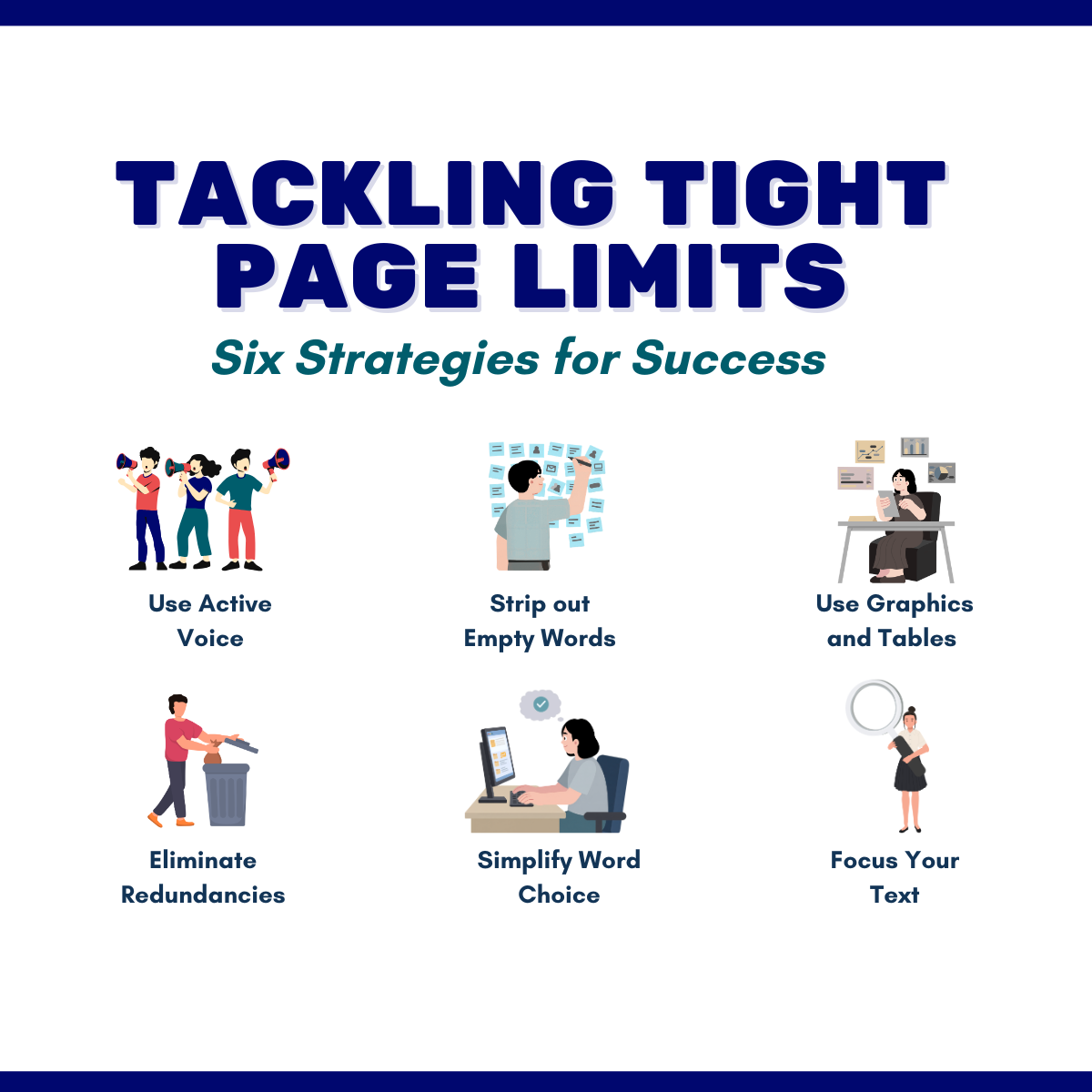
Use Active Voice

I know you hear this all the time, but active voice really is clearer because it forces you to articulate who is performing the action in the sentence. Without active voice, you can write an entire proposal and not know who is responsible for performing any of the tasks:


  • The Project Management Plan is implemented according to the schedule.
  • The systems are transferred over to the new platform.


Passive voice puts the subject and the action first, which can obscure who is performing the action. Passive voice also emphasizes the object of the sentence and can make your writing wordier and harder to follow. With active voice, the subject of the sentence comes first and performs the action in the sentence. Active voice is more straightforward and concise than passive voice. It also typically results in sharper sentences with stronger verbs:


  • The Project Manager implements the Project Management Plan according to the schedule.
  • Our experienced technicians transfer the systems over to the new platform.


As these examples demonstrate, active voice also flows better and is easier to understand.


Use Strong Verbs

Another way to make your writing clearer is to express actions in verbs. To do this, you should avoid using nominalizations where possible. Nominalizations are actions expressed in nouns rather than verbs. Examples include failure, investigation, movement, reaction, and refusal:


  • The program was a failure.
  • We conducted an investigation on the issue.
  • His reaction was positive.


Replacing weak verbs and nominalizations with strong verbs will make your sentences more dynamic, direct, clear, and concise:


  • The program failed.
  • We investigated the issue.
  • He reacted positively.


Eliminate Redundancies

Redundancies add extra words that can obscure your message rather than add value. Look for common redundant phrases that take up space but don’t add value, including:


  • Actual experience
  • Advanced planning
  • Close proximity
  • Consensus of opinion


Replace these redundant phrases with clearer verbiage:


  • Experience
  • Planning
  • Proximity
  • Consensus


Removing redundancies will help make your writing clearer and more concise, which in turn will make it easier to evaluate.


Simplify Your Word Choice

Writers sometimes feel compelled to add emphasis to their writing by using extra words or phrases that don’t contribute much to the meaning and frequently actually obscure it. Consider the following swaps:


  • Absolutely vital; replace with vital
  • Quite unique; replace with unique
  • Due to the fact that; replace with because
  • Utilize/Utilization; replace with use
  • In the amount of; replace with for
  • In the event of; replace with if
  • In order that; replace with for or so
  • Commence; replace with start


Using simple words and phrases will make your writing clearer so that the evaluators can easily understand your message and score you appropriately.


Final Thoughts

Poorly written, unclear proposals can obscure your message and make it difficult for evaluators to follow your proposal’s logic and main points. If you’re unclear in your writing, the customer can only assume that your communication will be similarly unclear in your contract delivery. Following these tips can help you to present your ideas more clearly so that evaluators can understand and more easily score your proposals. In addition to making your proposal easier to score, clear writing can contribute to your company’s credibility in the eyes of the evaluator—which can certainly help improve your chances of winning overall.


Written by Ashley (Kayes) Floro, CPP APMP

Senior Consultant and President

Proptimal Solutions, LLC

proptimalsolutions.com

LinkedIn


*originally published on proposalreflections.com
lightbulb bursting
By Ashley (Kayes) Floro, CPP APMP February 12, 2026
Winning new business in today’s competitive market, whether in the commercial or government space, depends on the strength of your proposals. Even highly capable organizations lose out when their submissions are generic, unclear, or non-compliant. Proposals that read like a generic product or service description fail to stand out among competitors. Maybe you have cut and paste boilerplate content and simply changed the customer’s name. Maybe you have had AI generate your proposal content but failed to tailor it. Maybe you simply know nothing about the customer because the capture effort fell flat. Maybe this was a pop-up solicitation that leadership insisted on bidding. Maybe you just didn’t have enough time to produce something stronger. The good news? Most proposal failures stem from a handful of common mistakes that can be avoided with the right strategies. This article explores those pitfalls and provides practical guidance to help you write proposals that stand out, speak directly to the customers’ needs, and maximize your chances of success. Mistake 1: Incomplete Capture Plan and No Customer Understanding At the heart of every successful proposal is a deep understanding of the customer. When your proposal speaks directly to your customer’s pain points and priorities, it becomes a solution that resonates. Most often, this customer understanding will come from the person nurturing the relationship with the customer—the capture manager. However, sometimes, for one reason or another, we have a missing or incomplete capture plan—and nobody on our team can shed light on what keeps our customer up at night. If you find yourself in this situation, one powerful shortcut you can use is generative artificial intelligence (AI). You can use AI tools like ChatGPT to analyze the customer’s issues and hot buttons so you can tailor your messaging with speed and precision. Just upload the solicitation to the AI tool (as long as it isn’t marked confidential, CUI, or something similar), and then include a prompt like the following: “What are the key issues and hot buttons that concern this customer?” The tool will quickly and effectively pull out tangible hot buttons and issues present in the solicitation that you can write to in your response. You can take this a step further and have the AI tool draft some messaging or positioning points. Though these will be somewhat high-level, and may include solution elements you need to validate, they will be a good start, and you’ll get them quickly. After you get your list of messaging or positioning points, you’ll want to validate any solution elements with your team. Then, add necessary specifics to take them from generic to compelling. Here’s an example: ChatGPT may come up with the following messaging point: Our implementation methodology with rapid prototyping and continuous customer feedback reduces risk and accelerates delivery timelines. To take this from generic to compelling, you’ll want to add specifics and metrics: Our low-risk approach cuts delivery timelines in half with our proprietary Agile-based implementation methodology, which drives rapid prototyping and incorporates continuous customer feedback. Mistake 2: You’re Not Articulating Your Value Once you have a baseline customer understanding, you should take time to develop strong win themes—concise, compelling messages that explain why your offer is the best choice. Emphasize what makes your solution unique and how it directly benefits the customer. Win themes should: Reflect the customer’s top priorities Highlight your differentiators Be repeated consistently throughout the proposal to reinforce your value For example, a win theme might be: “Our proven technology reduces operational downtime by 30%, helping achieve uninterrupted service delivery.” Once developed, reinforce these themes consistently throughout the proposal. Mistake 3: Your Proposal is Full of Unsubstantiated Claims To go beyond the generic and cookie cutter, you’ll also want to support your claims with evidence, such as case studies, metrics, past performance, testimonials, certifications, or pilot results. For example, after indicating that our advanced analytics enable the customer’s team to make faster, data-driven decisions that improve efficiency and reduce costs by 30%, we might include a proof statement of where we have achieved this success in the past: “For example, on XYZ contract, our advanced analytics enabled the customer to cut decision times in half and resulted in cost savings of $15 million.” By adding proof statements as evidence and backing up our claims with facts and figures, we provide the necessary proof to substantiate our solution with the evaluator. Quantifying our proof points will make our content even more credible. Additionally, demonstrating past success reduces the perception of risk and helps the customer gain confidence in your capabilities, especially when you tie your capabilities back to positive outcomes for the customer. Mistake 4: Overloading with Jargon and Technical Terms Subject matter experts sometimes write proposals using internal jargon or overly technical language that evaluators may not understand. If this is the case, you’ll want to take time to rewrite their inputs in clear, concise, and customer-focused language. Ensure your proposal tells a story that resonates with both technical and non-technical readers. Remember, evaluators often review dozens of submissions under tight deadlines, so complex wording, jargon, or filler language can slow them down—or worse, obscure your key messages. Every sentence should be easy to understand and tied directly to the customer’s priorities. But being concise doesn’t mean oversimplifying. It means distilling your ideas into their most impactful form. Replace long-winded explanations with direct statements and eliminate buzzwords that don’t add substance. For example, instead of saying, “Our innovative, cutting-edge, next-generation platform leverages advanced synergies to optimize mission outcomes,” you might write, “Our platform improves mission performance by reducing downtime by 50% and streamlining workflows.” Some tips for clear writing include: Use plain language: Write as though you’re explaining to a smart colleague outside your industry. Cut redundancy: If you’ve already made a point, don’t repeat it unless you’re reinforcing a win theme. Prioritize active voice: “We deliver results” is stronger and clearer than “Results are delivered by our team.” Use short sentences with strong verbs: Keep sentences focused and avoid unnecessary modifiers. Test readability: Read your proposal out loud to catch errors or awkward sounding sentences, and use the tools built into your word processing program to check sentence length and grade-level clarity. Concise, clear writing respects the evaluator’s time and ensures your strengths stand out without distraction. When every word adds value, your proposal communicates confidence, professionalism, and customer focus. Mistake 5: Missing or Buried Compliance Elements Proposals that fail to meet mandatory requirements or submission formats risk rejection or disqualification regardless of content quality. To avoid this mistake, create a compliance matrix early in the process to track all requirements. Include compliance as a key focus during color team reviews and consider assigning a specific reviewer to cross-read for compliance. Create a proposal production checklist that includes major compliance elements, and verify page limits, font size, document format, attachments, and signatures before submitting. Make sure to submit the proposal following the exact method required (e.g., online portal, email, hand delivery, courier, etc.). Additionally, to help make sure that evaluators can find all the required information, we also want to make sure our proposal is easy to score. Structure your response to the proposal instructions and the evaluation criteria. Next map in other requirements, as required. To facilitate evaluation, consider including relevant solicitation references in your section heading titles. Additionally, evaluators often do key word searches to find what’s important to them. Make sure all sections include key words from the instructions, evaluation criteria, and the statement of work/performance work statement. To make your proposal narrative even more evaluator-friendly, leverage feature and benefit tables and highlight proof points using callout boxes. Final Thoughts Strong proposals are the result of planning, discipline, and a clear focus on the customer. By avoiding common mistakes like generic content, jargon, missing compliance elements, or weak themes, you can transform your proposal from a basic response into a persuasive, customer-centered solution. Every submission is an opportunity not just to compete, but to build credibility and strengthen relationships. Approach each one as a chance to prove your value—and win with confidence. Originally posted on the Proposal Reflections Blog
Picture of a bullhorn announcing that active voice wins in proposal writing
By Ashley (Kayes) Floro, CPP APMP February 11, 2026
Active Voice: Because Evaluators Shouldn’t Have to Guess Who’s Doing What
Picture of a latte with the question, what's your proposal love language
By Ashley (Kayes) Floro, CPP APMP February 10, 2026
Borrowed from the classic five love languages, these are the ways proposal professionals most often give and receive appreciation during the proposal pursuit.