How to Establish a Successful Task Order Machine
Ashley (Kayes) Floro, CPP APMP • February 21, 2026


According to a 2023 report by the Coalitions for Government Procurement, Fiscal Year 2023 marked the third consecutive year in which over 50 percent of United States (US) federal contract spending was obligated using indefinite delivery/indefinite quantity (IDIQ) contracts . The report shows inflation-adjusted IDIQ spending exceeding $426 billion in Fiscal Year 2023, which represents about 56% of all federal contract spending that year.


With IDIQ contracts becoming more and more prevalent in the US federal government space, it’s critical that companies not only invest in the pursuit of IDIQ vehicles, but also establish a successful task order response machine. In this article, I’ll discuss how to do just that. First, I’ll quantify the Government’s task order spend to understand why having a successful task order process is so important. Next, I’ll review the steps necessary to establish a successful process, including establishing the infrastructure, conducting capture activities and using baseline resources, establishing and leveraging proposal management resources, generating and using boilerplate sections, and generating and using task order templates. I’ll review how to establish and execute the task order response process and conduct lessons learned and iterative process adjustments. Finally, I’ll conclude with some key takeaways.


Quantifying the Government Spend


First, let’s take a look at some numbers related to Government spending. According to that 2023 report by the Coalitions for Government Procurement, the US Federal Government spent more than $759 billion on contracts in Fiscal Year 2023, representing a five percent increase from the previous year. The Department of Defense (DoD) served as the largest source of contract spending, with over $470 billion in obligations, making up roughly 62 of all government contract spending. When it comes to the $426 billion spent on IDIQs, the DoD represented about 60 percent of that spending. Interestingly, the agencies that used IDIQ contracts the most were the Department of Treasury, the Department of Veterans Affairs (VA), and the Department of Homeland Security (DHS), with IDIQ spending accounting for more than 80 percent of their total contract spending.


Why Are Multiple Award Contracts Appealing?


Multiple award contracts are appealing to the Government because they create a smaller, down-selected pool of contractors from which to solicit work via task orders. For this same reason, winning these multiple award contracts are appealing to contractors. These vehicles reduce the number of possible competitors, which increases your odds of winning from the start. This down-selected pool also helps to pre-focus your competitive analysis activities.


Why Is a Solid Task Order Response Process Important?


Winning the IDIQ vehicle is just the first step. How often do we see companies spending good time and money on winning an IDIQ vehicle but then fall flat on the task order responses? This is why setting up a solid task order response process is so critical. But where do you start? First, you’ll need to set up a task order response infrastructure—establish the templates and tools necessary to respond. Next, you should establish a task order response process—document those predefined actions to take once a task order opportunity is identified. Once the process is documented, you’ll need to communicate the process to the team. Conducting training sessions can help ensure that key process elements are understood by all internal stakeholders and team members. Next, you’ll need to execute your task order process. Then after each task order response, you’ll want to conduct lessons learned and adjust your process as needed.
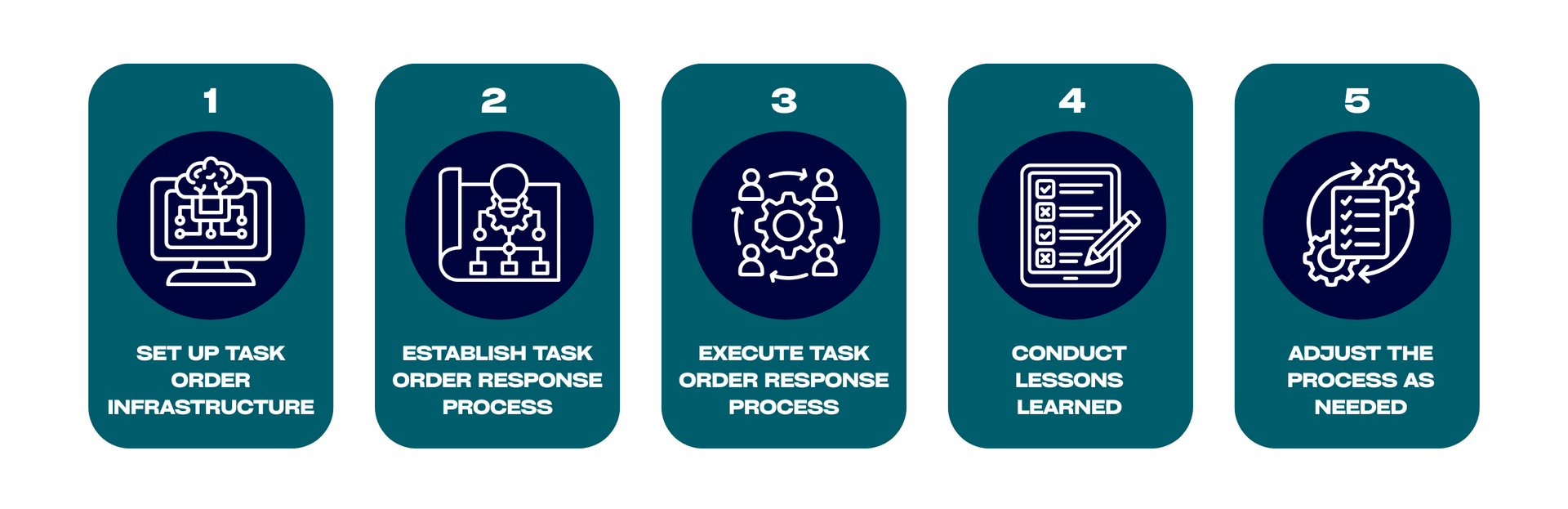
1. Establishing the Infrastructure


The typical task order turnaround is 10 days, so it’s critical that you set up the necessary infrastructure to support an agile response process. When setting up your task order response infrastructure, the first thing you’ll need to do is establish your forecasting and capture function. Understanding when the task orders are expected to be released will help you to prepare for the response in advance and will help prevent the mad scramble that so many companies have become accustomed to. Once you have the task order pipeline established, you’ll want to review the pipeline regularly with your team. Identify the must win task orders and focus your capture efforts on those targeted opportunities. Next, you’ll want to establish your response hierarchy within your proposal management tool (e.g., SharePoint). I recommend creating a main workspace for each IDIQ with sub-workspaces for each task order response.


At the IDIQ level, you’ll want to include key resources including the IDIQ Contract, the IDIQ proposal, sample past performance write-ups, boilerplate sections, task order templates, and sample graphics.


For each task order response workspace, you’ll want to include folders organized to support your task order response process. These folders include Solicitation Documents, Reference Materials, Capture Management, Proposal Management, Working Drafts, Review Files, Production, Graphics, and Final Submitted Files.


Task Order Capture Management


Capture is one area that we tend to skimp on when responding to task orders. However, this is a huge mistake. Capture is just as important for task order responses as it is for single award contracts—particularly for your larger and must win task orders. For each of your must win task orders, you’ll want to identify and meet with relevant stakeholders, including the end customer and decision makers. You’ll want to do the necessary research to understand who they are, what they care about, what their hot buttons are, what their goals are with the procurements, any issues they might be experiencing on current work, and any other information that would be helpful in developing a tailored and winning solution. As part of your capture efforts, you’ll also want to identify the top competitors. Document their strengths, weaknesses, and likely solution—including their expected price.


If you allow sufficient time, after you understand the customer and their needs, you’ll want to begin “shaping” the opportunity. You can do this by submitting white papers and conducting presentations. If a draft Request for Proposal (RFP) is released, you should also submit red-lines and recommendations. For example, you might recommend relevant past performance requirements, solution elements, scope content, and key personnel requirements. Of course, in doing so, make sure the changes will be to your company or team’s benefit. It’s also critical to communicate clearly to the Government why including these things might be beneficial to them, particularly as they relate to reduced risks, increased efficiencies, and cost savings. If these recommendations show up in the final task order RFP, you know you’ve successfully shaped the opportunity.


In addition to opportunity shaping, during the capture phase you’ll want to document the key issues, features and benefits related to each major task order requirement (e.g., technical, management, staffing, etc.). You’ll also want to document your ideal solution based on the feedback you’ve received from your customer meetings. Using the information you’ve gathered, document your win themes and section themes—those hard hitting statements that will tell the government why they should select you. This information should feed your draft executive summary—which you should try to finish before the final RFP is released. Finally, you’ll want to have your bid/no-bid decision checklist or decision matrix ready for when that final task order RFP is eventually released.


Key Proposal Management Resources


Your response library should include key proposal management resources within the Proposal Management folder. These include sample schedules for common response turnarounds (e.g., 5-day, 10-day, 20-day, and 30-days), questions templates, points of contact lists, compliance matrix templates, review templates, and task order templates.


The Importance of Boilerplate Materials


You’ll also want to include boilerplate or reuse sections in your response library. These should be specific to the typical task order requirements, but will likely include cover letters, executive summaries, corporate capabilities, past performance write-ups, management plans and/or approaches, subcontracting plan and approach, technical approaches, and pricing approaches. For each of these sections, it’s helpful if you maintain these in the task order template and include content commonly asked for in the task order RFPs. Specifically for past performance, you’ll also want to maintain an up-to-date list of internal and external points of contact (e.g., project managers, technical points of contact, and contracting points of contact). Your management plan and/or approach should typically contain reuse content related to your project organization, transition approach, staffing approach, quality approach, safety measures, risk mitigation and management, schedule management, and cost controls. For the pricing template, you might include your cost accounting systems and standards, descriptions of your purchasing systems, descriptions of your estimating systems and procedures, Defense Contract Audit Agency (DCAA) and Defense Contract Management Agency (DCMA) point of contact and any audit results, and any forward pricing rate agreements you may have in place.


Having strong boilerplate in place will help you to respond to task orders more efficiently because the baseline content is already ready. To facilitate even faster responses, include the most common boilerplate directly in the templates and other less common reference material as content to be inserted as required. I recommend leaving customer names out of your boilerplate to reduce the chances of accidentally leaving the wrong customer name in your task order response. Instead, replace customer names with the highlighted word <CUSTOMER> in all caps with angle brackets. This will facilitate easy find and replace and help prevent incorrectly replacing generic references to customers. I also recommend including mad lib like theme statements for your major sections. For example, in your transition section, you might include something like the following: To support a successful and low risk transition for <CUSTOMER>, our Transition Manager, <TRANSITION MANAGER NAME>, brings X years of experience transitioning projects of similar size, scope, and complexity to TASK ORDER NAME. This includes successfully transitioning more than X personnel onto the $X million contract name in less than x days/weeks/months.


In addition to maintaining narratives that can be tailored for each task order, I recommend also keeping a list of relevant proof points and facts that can be dropped into boilerplate that can be used to quickly tailor the content based on the project type and customer. Some examples of recommended proof points include the years of experience supporting common customers, the years of experience delivering common services, the number of facilities, the number of staff in common labor categories, and the number of cleared staff (if applicable). It’s also helpful to maintain some short past performance vignettes demonstrating transition successes, staffing ramp-ups, transformation success stories, successful implementations, demonstrated cost savings, process efficiencies, and any other relevant success stories.


Task Order Templates


Because the format requirements generally remain consistent from task order to task order, having pre-set task order templates ready before the RFPs drop will save you so much time. Your templates should include editable covers with placeholders for required information, editable headers and footers (also with placeholders for required information), as well as built-in styles set to meet common task order RFP requirements. At a minimum, set these built-in styles for headings, body text, bullets, table text, table bullets, figure titles, and action captions.


To further streamline your task order templates, I recommend pre-outfitting the templates with headings mapped to the most common task order requirements. Under each major requirement, drop in boilerplate that can be adjusted quickly with find and replace. Also include editable callout boxes as reminders for your team to add in relevant proof points and success stories. Additionally, make sure you include placeholders for common graphics, including organization charts, quality graphics, process flowcharts, risk matrices, and schedules.


2. Establish Your Response Process


Once you have your infrastructure in place, you’ll want to establish an easy-to-follow response process. This process should include task order capture activities (which I discussed earlier), task order RFP distribution and review, the bid/no-bid decision, resource assignments, shell document development (that is, adjusting the baseline template based off task order RFP specific requirements), questions collection and submission, draft development, review cycles, editing and finalization, and proposal submission. Generating a simple checklist with roles and responsibilities can help make sure your team never misses a beat.


3. Execute Your Response Process


It’s one thing to establish your process, but it’s another thing entirely to execute the process. Once you have firmed up your process, it’s critical that you distribute the process documents to the team. Additionally, keep your process documents electronically in a central location that everyone can find and access. Then, you should hold training sessions as early as possible with your team. During the training, walk through the response process, review roles and responsibilities, and demonstrate how to use the proposal site. You should review the site structure, version control measures, boilerplate availability, as well as the process for updating boilerplate content. Be prepared to execute just-in-time refresher training as well. It’s also helpful to communicate next steps throughout the task order response process so that the team can easily stay on track.


4. Conduct Lessons Learned


After each submission, conduct a brief lessons learned session. Additionally, win or lose, you’ll want to request a debrief from the Government. This will enable you to gather trends on things you’re doing well as well as things that need improvement.


5. Adjust Process as Needed


If you notice the same issue repeating itself during each response, then you may need to adjust the process to mitigate that problem for future submissions. For example, if you’re consistently losing on price, identify gaps in your capture processes as well as areas you can generally become leaner in your pricing. If your response lacks customer understanding, there may be gaps in your capture process, knowledge transfer, and/or bid-decision process. If non-compliances are noted, you may need to examine and adjust your outlining practices, writing process, review processes, and/or boilerplate content.


Final Thoughts


To effectively capture and win business under your IDIQ vehicles, an effective and efficient task order response process is critical. The most important step is to plan, capture, and prepare. This will support stronger task order content and faster turnarounds. Then, establish and document your task order response process, and make sure you communicate the process, including roles and responsibilities. This understanding of accountability will help ensure the process goes smoothly. Make sure you focus on and prioritize the must-win task orders. By focusing on strategic opportunities rather than simply playing a numbers game, you increase your win probably on the targeted efforts and should see an overall improved win rate across the task orders. If you’re juggling multiple concurrent task order responses, be sure to maintain a master schedule with all the task order deadlines and milestones. This will mitigate resource conflicts and help you successfully manage multiple task orders. Finally, conduct internal lessons learned and request debriefs, win or lose. As necessary, adjust your process to mitigate future issues.


Remember, winning the IDIQ is only the first step. You need to establish a successful task order machine to start winning those task orders!
Proposal team storyboarding
By Ashley (Kayes) Floro, CPP APMP February 25, 2026
In proposal development, the difference between a rushed response and a winning one often comes down to planning. One of the most effective planning tools is storyboarding—the process of transforming strategy and requirements into a clear, organized roadmap for writers. Storyboarding bridges the gap between big-picture strategy and detailed content. Instead of diving straight into writing, it forces teams to pause and address critical questions up front: What win themes should we emphasize? How do we differentiate ourselves from competitors? What proof points and evidence will make our claims credible? By answering these questions early, proposal teams ensure the final product reflects a deliberate strategy rather than a patchwork of boilerplate. This step is especially important in complex proposals where multiple authors contribute. Without storyboards, sections can easily become repetitive, inconsistent, or off message. With storyboards, however, teams gain a shared outline, unified messaging, and a structured plan that keeps writing focused, compliant, and persuasive. Storyboarding also accelerates the writing process by reducing blank-page paralysis, supporting early graphic planning, and revealing gaps in data or compliance before they derail schedules. In short, it gives teams the clarity and confidence needed to write stronger proposals. What Is Storyboarding? Storyboarding is the process of outlining the content and structure of your proposal sections before writing begins. Think of it as creating a blueprint: it shows the writer what to say, in what order, and with what supporting evidence. Storyboarding is important because: It keeps the writing aligned with the win strategy. Storyboards tie each section to evaluation criteria, customer hot buttons, and discriminators. It saves time. Writers work faster when they know what to write, and what not to. It improves consistency. When multiple authors contribute to a proposal, storyboards provide a shared vision that keeps the tone, content, and structure cohesive. Best practices for storyboarding include: Incorporate key messaging. Highlight your themes, benefits, and proof points in each section. Make them visual when possible. Use tables, diagrams, and callouts to plan graphics and reinforce major messages. Include RFP references. Tie each storyboard element to a specific section or instruction from the solicitation. Assign clear owners. Each storyboard should name a lead writer, contributors, and reviewers—along with target dates. Encourage teamwork and cross-reading. Storyboarding works best when it isn’t done in silos. Have multiple contributors work together to complete each storyboard. Then have the different section contributors cross-read the other storyboards to make sure there is consistency in the approaches. Storyboard Template Below is a sample storyboarding template that can be modified to align with your solutioning process. This format helps writers map out proposal content section-by-section, ensuring alignment with requirements, win themes, and the approved solution.  - - - - - - - - - - - - - - - - - - - - - - - - - - - - - - - - - - - - - - - - - - - - - - - - - - - - - - - - - - - - - - - - - - - - - - - - - - - - - - - - - - - - - - - - - - - - - - - - - - - - - - - - - - - - - - - - - - - - - - - - - - - - - - - - - - -
graphs with upward trend and text
By Ashley (Kayes) Floro, CPP APMP February 24, 2026
Winning proposals don’t just happen because the solution is strong—they happen because the proposal is structured to earn points. Too often, teams focus solely on what they want to say, rather than how evaluators will read, interpret, and ultimately score their response. If you want to increase your probability of win, you must first understand how proposals are evaluated and then write with that scoring process in mind. By aligning your content to evaluation criteria, highlighting clear strengths, and making it easy for evaluators to assign high ratings, you can transform a compliant submission into a high-scoring, competitive proposal. Understanding Proposal Evaluation Before we can really understand how to make proposals easier to score, we have to understand how proposals are being evaluated. The first thing to understand is that proposals are typically first reviewed for compliance with the requirements as outlined in the proposal instructions. Next, the proposals are scored based on the evaluation criteria. Customers frequently assign strengths, weaknesses, and deficiencies to back up their scores. To receive an “Exceptional” score, your strengths have to outweigh any weaknesses, and no major deficiencies can be present. When using this scoring method, a deficiency is typically defined as a material failure of a proposal to meet a customer requirement or a combination of significant weaknesses in a proposal that increases the risk of unsuccessful contract performance to an unacceptable level. A weakness is defined as a flaw in the proposal that increases the risk of unsuccessful contract performance. And significant strengths are defined as aspects of an offeror's proposal that have merit or that exceed specified performance or capability requirements in a way that will be advantageous to the customer during contract performance. In our proposals, we want to minimize any weaknesses and deficiencies and maximize our strengths and significant strengths. Organize Content So It’s Easy to Score Understanding that proposals are scored, it makes good sense that when we’re writing proposals, we need to present the information in a way that is easy for evaluators to score. Most evaluators do not volunteer for the job and do not particularly enjoy it. It takes time away from their regular job, so they want to get it over with as quickly as possible. Therefore, we should aim to make the evaluator’s job as easy as possible. To make your sections easy to score, structure your response to the proposal instructions and the evaluation criteria. Next map in other requirements, as required (e.g., elements of the statement of work). To facilitate evaluation, consider including relevant RFP references in your section heading titles; this helps evaluators understand the logic of your organization and map your responses back to their evaluation scoresheet. Use RFP Language When writing proposals, you should also strive to use the language in the RFP to make the evaluation easier. For example, if the RFP asks for a Program Manager, you should use the title, Program Manager, not Project Manager. You should also strive to use the customer’s terminology and lexicon in our proposal to gain the customer’s confidence. By knowing your customer and speaking their language, you demonstrate that we understand them, and you begin to establish trust. What’s more, your customer evaluators often do key word searches to find what’s important to them in your proposals. To support them in this endeavor, you should make sure all sections include key words from the instructions, evaluation criteria, and the statement of work. Theme Statements Another way to help evaluators to score you higher is to include theme statements or strength statements consistently throughout your response. Theme statements set the stage for the section and grab the evaluator’s attention because they address an issue that is important to them. The ideal theme statement not only presents a solution feature that addresses a customer hot button, it also articulates clear, quantified benefits. I recommend including a theme statement for every first-level section and second-level subsection and formatting those themes to stand out from the rest of the text. If you theme effectively, the theme statements will show up as identified strengths in the evaluation debrief from the customer. Callout Boxes Another way to arm evaluators with the ammunition they need to give you a high score is to use callout boxes to help your major proof points stand out. Be sure that your proof points not only highlight quantified metrics, but make sure to provide the “so what?” statement as well. For example, it’s not enough simply to state: “We have used our proven staffing process to staff programs with 3-, 7- and 14-day turnaround times, including the MNOP program, where we staffed 15 FTEs in two weeks.” Ask yourself, “So what? What does this mean for my customer?” This might prompt you to add, “Leveraging this staffing process, we provide Customer ABC with low-risk task order start-up and delivery for large, small, short-term, and long-term requirements.” Feature and Benefit Tables Feature and benefit tables are another great way to help evaluators find proposal strengths. Similar to theme statements, feature and benefit tables highlight major solution features—that ideally address customer hot buttons—and articulate clear, quantified benefits. Typically, customers want things cheaper, faster, and/or better, which we might express as low cost, low risk, high quality, efficient, and/or effective. Use feature and benefit tables in each major section introduction to highlight the key elements of your approach. This could be every first-level section for shorter proposals, but it may be extended to each second-level subsection for longer proposals. Articulate Benefits Throughout As touched on previously, benefits tell the customer why they should care about our solution or its features; they articulate the “so what?” But, it’s critical to remember that benefits should be things that the customer cares about. For example, if the customer doesn’t care whether the transition is completed in three weeks or six weeks, then expedited timeline is not a benefit to that customer. It’s also critical to remember that benefits should be highlighted throughout the proposal narrative. It’s not enough for benefits to show up in theme statements, callout boxes, and feature benefit tables—these benefits need to be articulated and reinforced throughout the proposal narrative as well. Make the Response About the Customer Another critical way to score higher is to make sure you are focusing on the customer. Two key signs that your proposal writing lacks customer perspective include: (1) the proposal mentions your company or team name more than the customer’s name; (2) the proposal is about your company’s offer instead of the solution and benefits the customer will receive. A great proposal is about the customer and the benefits they receive from the proposed solution. One of the easiest ways to make our proposal content more customer focused is to put them first—literally. Instead of saying, “Team ABC’s solution delivers a low-risk transition,” flip the construction and write, “Customer A receives a low-risk transition with our comprehensive transition approach.” The two sentences convey the same overall message, but by putting the customer first in the sentence, we shift the focus onto what the customer is receiving rather than what we are delivering. Another easy way to make your proposal content more customer focused is to use the customer’s name more frequently than your company or team name. To validate whether you are doing so, you can try this quick test: hit Ctrl-F and search for the number of times you mention your company and/or team name; then search for the number of times you mention the customer’s name. You should aim to mention the customer’s name more times than yours. If you find that you have mentioned the customer far less frequently, you should revise our text to focus more on the customer and the benefits they will receive by choosing your solution. Final Thoughts In this world of bids and proposals, we all certainly want to win more. However, there are so many factors that impact a company’s probability of win, and a number of things throughout the opportunity lifecycle can impact a company’s chances of winning (both positively and negatively). Although the capture phase has the greatest potential to positively impact your chances of winning, you can certainly take steps to help your proposals score higher during the proposal writing stage. These actions include organizing content so it’s easy to score; using RFP language, theme statements, callout boxes, and feature and benefits tables; articulating benefits throughout the response; and making the response about the customer. These critical components during the writing phase can go a long way in facilitating the evaluation process and increasing your overall score—and a higher score can easily translate to a higher probability of win! 
AI robot writing proposal content
By Ashley (Kayes) Floro, CPP APMP February 23, 2026
The use of generative artificial intelligence (AI) tools is becoming almost commonplace in our daily lives, much in the same way that we use cell phones and the internet without a second thought. And why not—it’s so easy to enter a prompt into ChatGPT and use the response to start an email, thank you letter, or social media post. So, it’s not surprising that the explosion of generative AI tools like ChatGPT, Claude, and others has sparked major interest—and debate—among those in the proposal community. AI promises so many benefits to our proposal process: it can save time and increase productivity, it can help brainstorm win themes and messaging, it can improve readability and clarity, and it can serve as a knowledge assistant. This can help reduce burnout on proposal teams since AI is saving the team time doing the “grunt work” so that proposal team members can focus on higher-value tasks. However, AI use does not come without potential risks, including confidentiality and data security risks. Inputting sensitive content—like solution content, past performance content, pricing, client names, etc.—into public AI tools can breach Non-Disclosure Agreements (NDAs) or contracts, expose proprietary or competitive information to third parties, or violate privacy regulations. Knowing the potential benefits, as well as the risks, you and your teams may be asking how you can responsibly use AI to draft sections, develop win themes, or tailor boilerplate content. And how can you do so without introducing AI generated errors? Let’s dig into it! How You Can Responsibly Use AI to Draft Sections, Develop Win Themes, or Tailor Boilerplate Content If used responsibly, you can use AI prompts to suggest creative ways to frame your team’s differentiators and benefits, help align your solution with the customer’s priorities and hot buttons, and provide alternative ways to express key messages to keep language compelling. You can also use AI to help rewrite dense, jargon-heavy technical text into clear, persuasive, customer-focused content. Here are some ways you can minimize risk while using AI to support proposal development: Set a policy and train your team Never input confidential or proprietary information into public AI tools Always treat AI output as a draft, never a final deliverable Set a policy and train your team Before you allow teams to start using AI to support proposal development, you should create a written guideline or policy. The policy should define when and how team members may use AI, which tools are approved, and how to mitigate risks while using AI. The policy should define clear boundaries for AI use, considering where it adds value and where it doesn’t. Remember, AI is good for things like: Drafting boilerplate content, like company overviews or standard capabilities statements (after it is fed with source materials) Generating ideas for win themes based on key differentiators and customer hot buttons you provide (note that capture still has to provide this information!) Helping tailor boilerplate to meet solicitation requirements Checking readability and suggesting stylistic improvements Summarizing content AI is not good for: Making compliance decisions: it may miss mandatory requirements Factual accuracy: it can invent or misstate facts Interpreting ambiguous solicitation language: human judgement is still needed for this! Once you set the guidelines, train your team! Make sure everyone knows and understands the guidance. Be sure to highlight the data privacy risks and concerns. For many companies, entering proprietary data into a public AI tool may be grounds for termination. Never input confidential or proprietary information into public AI tools Although we have already touched on this point, it really deserves some additional attention. But the bottom line is that you should never paste client-sensitive content, proprietary solution information, or internal pricing into tools like ChatGPT unless your company has a private, secure instance. Many public AI tools store user inputs and use them to further train their models. That means your sensitive information could remain on their servers indefinitely—and possibly reappear in responses to other users. Even with private, secure instances, some companies may be concerned with data breaches or cyber-attacks. If this is the case, consider developing a policy to redact or anonymize sensitive names and figures before asking AI to help tailor content, even in your private instance of the tool. Always treat AI output as a draft, never a final deliverable While I was at the APMP Bid and Proposal Conference in Nashville earlier this year, I heard a story about a team that was thrown out of competition because they used AI to write their proposal and then didn’t tailor it. The customer told them that another team submitted the exact same response. I am not sure I was able to hold back the level of shock that a team would submit content without adjusting it—but after hearing that story, this really needs to be said. For so many reasons, you should always review, revise, and tailor the content you receive from your AI tool. The best advice I have heard is to treat AI like a junior writer or assistant—its suggestions still need review, fact-checking, and editing by your experienced proposal team. Just like we have always done as part of our proposal best practices, have a human team member review all your content for compliance, accuracy, your specific proposal style guide, and tone—especially the content developed initially by AI. How Can You Avoid Introducing Errors or “Hallucinations” When Using AI? In the context of generative AI tools, a hallucination happens when the AI generates output that is factually incorrect or fabricated, but it still presents the information confidently, as though it were true. Examples of common AI hallucinations include: Inventing a certification your company doesn’t hold Citing a law, regulation, or standard that doesn’t exist Referencing past performance examples or customer names that aren’t real Providing made up statistics or figures Hallucinations happen because AI models don’t actually know or understand facts—they predict likely sequences of words based on patterns they’ve seen during training. When they can’t find the answer in the data they were trained on or in what you provided in your prompt, they sometimes simply generate something that sounds plausible. This is why, especially when teams are using AI, it is critical for proposal managers and Subject Matter Experts (SMEs) to actively stay involved throughout the process. Here are some steps you can follow to help avoid hallucinations and errors when using AI: Always start with a compliance matrix Get back to the basics: build your compliance matrix first and track every requirement explicitly. You can have AI generate a first cut, but then you need to go back and add in everything that the tool may have missed. Next, just as best practice has always told us to do, have a human peer review and validate the matrix. Then use the matrix as the source of truth, and verify that every section written, whether by AI or by a human, maps back to the correct requirement. Remember, AI can help you phrase responses, but it doesn’t reliably recognize all mandatory instructions, page limits, or formatting rules. Use AI as a support tool, not a decision-maker Remember that AI can draft, suggest, and rephrase, but it doesn’t understand the legal or contractual weight of a solicitation. We’ve mentioned this already, but always have a SME and/or compliance lead review every section of the response. Don’t throw out your best practice review cycles! Fact-check everything Again—another “old school” best practice that has become ever more important in the age of AI. Because AI is prone to hallucinations, it may confidently invent product specifications, certifications, client names, or achievements. To catch these errors, first make sure you provide the AI with accurate source material. Then as part of your review process, require the reviewers to check all the information, including data points, dates, names of agencies or organizations, and references to laws, standards, or regulations. Feed AI verified content: don’t let it guess Don’t ask AI open-ended questions, such as “What are the key benefits of our solution?” unless you also give it source content to work with. Instead, first give the tool your actual product or solution specifications, differentiators, and past performance examples and ask it to organize, rephrase, or summarize those into proposal language. Remember, only do this if you are using a paid/private version of the tool. Leverage secure, organization-approved AI tools If you are going to introduce AI tools into your proposal process, it’s best to use private or enterprise-grade AI systems that can be fine-tuned on your approved boilerplate and style guides. Public tools are trained on general data and will be less aligned with your standards—and they also pose serious confidentiality and data security risks if not used carefully. Final Thoughts As generative AI tools continue to evolve and become more embedded in our workflows, proposal teams have an opportunity to harness them responsibly and effectively to produce efficiencies in our winning proposal processes. By understanding both the benefits and the risks, and by establishing clear policies, training, and review processes, you can use AI to enhance productivity without compromising compliance, accuracy, or confidentiality. Ultimately, AI should serve as a supportive assistant, not a substitute for human judgment, expertise, and quality control. Remember: Always fact-check AI output against trusted sources Provide the AI tool with accurate, complete input material (don’t let it guess) Have SMEs review content for accuracy Don’t let AI generate sections from scratch without oversight With the right balance, AI can help your team work smarter, reduce burnout, and deliver stronger, more competitive proposals!