Six Strategies to Tackle Tight Page Limitations

Ashley (Kayes) Floro, CPP APMP • March 25, 2026

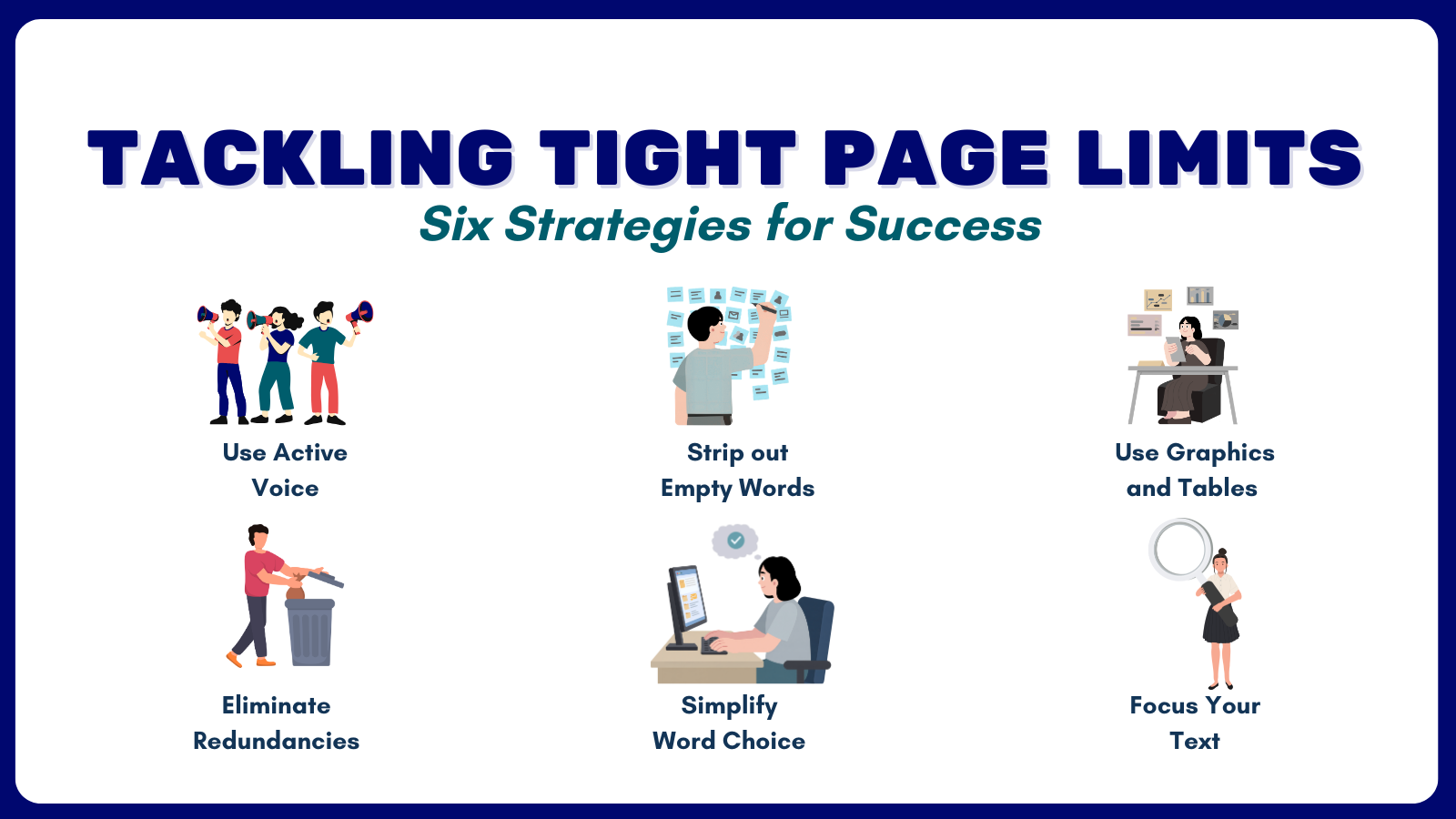
Tight page limitations are continuing to be a challenge as contracting officers streamline their acquisition processes. When faced with tight page restrictions, we often find ourselves struggling with trimming five pages of material into two pages of allocated space. However, sometimes the content we are working with is so long because it is simply overly wordy. In this article, I present six tricks for eliminating waste.


1. Use Active Voice

With active voice, the subject of the sentence comes first and performs the action in the sentence. Active voice is more straightforward and concise than passive voice. It typically results in shorter, sharper sentences. So not only does it take up less real estate, it flows better and is easier to understand.


Passive:

It was decided by the Program Manager to streamline the program.


Active, Strong Verb:

The Program Manager streamlined the program.


2. Eliminate Redundancies

Remove redundancies that take up extra space and don’t add value.


I present some examples below.


Redundant Simplified
actual experience experience
advanced planning planning
close proximity proximity
consensus of opinion consensus

Concise writing makes your response clearer and easier to evaluate.


3. Strip out Empty Words

Avoid empty words such as high, numerous, and highly reliable. Substantiate all empty claims with proof points and metrics, quantified if possible. Also, avoid clichés that add no value; for example, world class, best of breed, and silver bullet.


4. Simplify Your Word Choice

Writers sometimes feel the urge to add emphasis to their prose by using extra words or phrases that don’t contribute much to the meaning (and sometimes obscure it).


Consider the following swaps.

Wordy Simplified
absolutely vital vital
quite unique unique
due to the fact that because
utilize/utilization use
in the amount of for
in order that for, so
commence start


Visit https://digital.gov/guides/plain-language for a more comprehensive list.


5. Use Graphics and Tables Strategically

We’ve all heard the old adage, “A picture [or graphic] is worth a thousand words.” If used correctly, graphics are compelling, easy to understand, informative, and help to communicate your message faster and more clearly than words alone. Graphics can help evaluators to easily read data, understand processes, and identify patterns or potential opportunities. Graphics and tables typically also receive some font size relief—so if used appropriately and strategically, they can help to save you some valuable proposal real estate.


6. Focus Your Text

When page limitations are tight, it becomes even more critical to focus your text on the instructions and evaluation criteria. Look for areas where the content strays to work in tangential proof points, and move the unfocused text to the more relevant section or sections. Frequently you’ll find that the proof points or content are already present in the more relevant sections, and that you can just eliminate the text as redundant content. If you find that the content doesn’t really fit another section well, remove it completely since it does not support the proposal evaluation.


Final Thoughts

As tight page limitations continue to be a challenge, we need to approach our proposals with a strategy for keeping our content lean. By focusing our text, using active voice, and simplifying our word choice, we’ll begin the revising process with shorter narratives. Going back and stripping out empty words, eliminating redundancies, and using graphics and tables strategically will help to tighten our content further. Not only will you find that your content is shorter, but you’ll find that these strategies actually help to make your content clearer. If the evaluator actually understands what you are writing, that will help them award you the score that you actually deserve. In the end, though it might seem tedious, this trimming exercise can become a win-win situation for everyone involved.


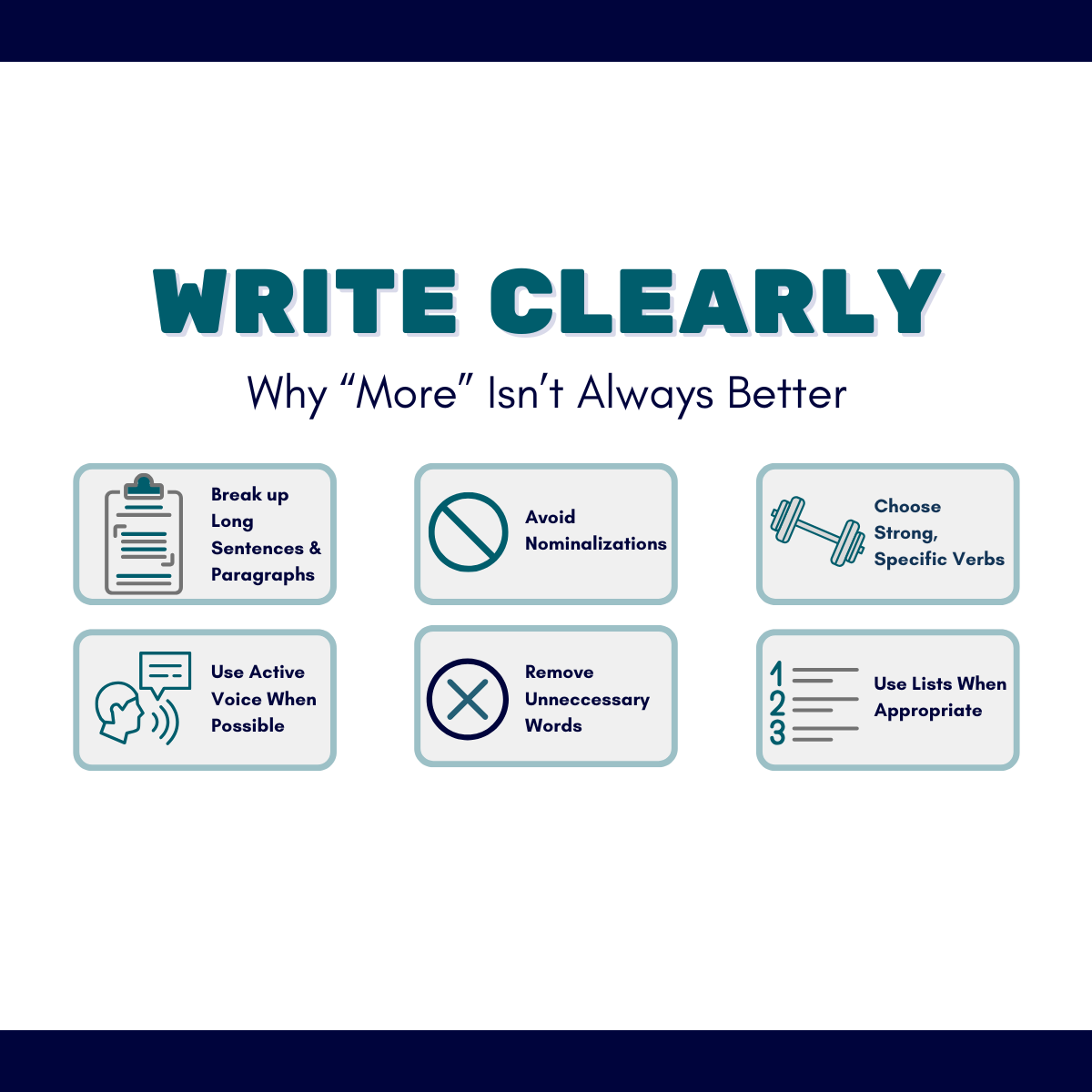
icons demonstrating how to write clearly
By Ashley (Kayes) Floro, CPP APMP March 23, 2026
In the world of proposal development, there’s a persistent misconception that longer writing signals deeper thinking. Teams sometimes feel pressure to fill pages, add more qualifiers, or expand explanations in hopes that additional words will make their message more persuasive. However, the opposite is often true. Clear writing is powerful because it makes it easy for the reader to understand, evaluate, and remember your message. The goal should be clarity, not volume. The most effective writers know that concise, direct language carries more impact than dense paragraphs and complicated phrasing. In this article, we present seven practical tips to help you write more clearly and effectively. 1. Break Up Long Sentences and Paragraphs Long sentences are one of the most common causes of unclear writing. When a sentence stretches beyond 25–30 words, it is easy for readers to lose track of the main point. Instead of packing multiple ideas into a single sentence, break them into shorter, focused statements. Each sentence should communicate one main idea. Example Less clear: Our team will implement a comprehensive data management framework designed to enhance reporting capabilities while also improving accessibility for users across multiple departments. Clearer: Our team will implement a comprehensive data management framework. This approach improves reporting and makes data more accessible across departments. Shorter sentences reduce cognitive load and help readers absorb information quickly. Similarly, large blocks of text can overwhelm readers. Each paragraph should focus on a single idea or topic. If a paragraph begins to cover multiple points, consider splitting it. Shorter paragraphs make it easier for readers to scan and process information. 2. Avoid Nominalizations Nominalizations occur when verbs are turned into nouns, often ending in -tion, -ment, or -ance. While they are sometimes necessary, they can make writing more abstract and wordier. Whenever possible, convert nominalizations back into strong verbs. Example Wordy: The implementation of the solution will result in the improvement of operational efficiency. Clearer: Implementing the solution will improve operational efficiency. Strong verbs make writing more direct and easier to understand. 3. Choose Strong, Specific Verbs Weak verbs like make, do, provide, conduct, or perform typically require additional words to explain what is happening. Strong verbs communicate action more clearly and concisely. Example Weak: Our team will conduct an analysis of system performance. Stronger: Our team will analyze system performance. Replacing weak verb phrases with precise verbs makes writing sharper and more confident. 4. Remove Unnecessary Words Many phrases in proposal writing add length without adding meaning. Words like very, really, quite, and in order to clutter your sentences. Look for opportunities to tighten phrasing. Examples In order to → To Due to the fact that → Because At this point in time → Now The goal isn’t to eliminate detail, it’s to eliminate filler. 5. Use Active Voice When Possible Active voice makes it clear who is responsible for an action and typically produces shorter sentences. Passive voice can be useful in certain situations, but overuse can make writing vague and indirect. Example Passive: The report will be completed by the team next week. Active: The team will complete the report next week. Active voice improves clarity and accountability. 6. Use Lists When Appropriate When presenting multiple related items—steps, benefits, features, or requirements—lists can improve readability. Lists allow readers to quickly understand key points without digging through dense paragraphs. They also highlight structure and make complex information easier to follow. Final Thoughts When readers can quickly understand your message, they are far more likely to absorb your ideas and act on them. Remember: strong writing isn’t measured by how many words you use. It’s measured by how clearly those words communicate your message.
color team review
By Ashley (Kayes) Floro, CPP APMP March 20, 2026
Everyone wants Artificial Intelligence (AI) to be the silver bullet that finally fixes the proposal process. Faster content, fewer late nights, no more staring at a blank page. And honestly? AI does help. But there's one thing it hasn't changed—and that most proposal professionals still don't want to hear: you still need color team reviews. Here's why that's still true, even in the age of AI. Procrastination doesn't care what tools you have According to the National Institutes of Health, up to 95% of adults procrastinate, and approximately 20–25% are chronic procrastinators. About 88% of the workforce procrastinates for at least one hour a day. AI makes content generation faster, but it doesn't make humans more disciplined. Writers will still wait until the last minute. They'll still generate a first draft and call it done. Established proposal methodologies—from APMP best practices to decades of hard-won industry experience—exist precisely to fight this tendency: daily stand-ups, interim deadlines, and structured reviews that force consistent progress rather than a last-minute scramble. The first draft is never the final draft — AI or not For decades, English teachers have required students to submit multiple drafts for exactly this reason. Writing is a process of thinking. Multiple iterations help writers clarify ideas, improve organization, and refine content based on feedback. AI can accelerate the drafting stage, but it can't replace the critical eye of a reviewer who understands your win strategy, knows the customer, and can spot a weak discriminator from across the room. Stakeholder surprises at submission are still catastrophic Here's what poor planning actually looks like in practice: you're ready to hit submit, and a key stakeholder wants something changed at the last minute. A seemingly small thing to them that requires hours of rework: checking cross-references, adjusting content across multiple volumes. Or worse, they reject the entire proposal and demand a full rewrite, with a deadline early the next day. AI doesn't prevent this. Only early, structured stakeholder engagement does. Color team reviews aren't just about catching bad writing. They're about building the buy-in you need before it's too late to act on it. The problems are old. The tools are new. The process still works AI has changed how fast we can produce a draft. It hasn't changed human nature, the need for iteration, or the cost of a stakeholder blindside at the finish line. These structured methodologies were built around enduring realities—and those realities haven't gone anywhere just because the drafting got faster. I get it: color team reviews suck. But proposals without them suck more.
broken business development process
By Ashley (Kayes) Floro, CPP APMP March 18, 2026
In the current business environment, there is a lot of buzz out there promising how Artificial Intelligence (AI) can fix your proposal process. And maybe your proposal process is broken. But I’m willing to bet that if your proposal process is broken, the rest of your business development process is probably broken too. What do I mean? I mean that in a lot of cases, the reason proposal teams are scrambling is because: Bid decisions are delayed There are too many proposals in the pipeline to manage using the existing resources Teams are pursuing opportunities with low probabilities of win Solution development is happening after the request for proposal (RFP) release There’s a lack of opportunity, customer, and competitor information When your proposal teams start from a competitive disadvantage, it doesn’t really matter how good or bad the proposal process is. You’re setting your teams up for failure. Business Development Lifecycle Market Segmentation, Long-Term Positioning, and Opportunity Analysis (typically, 3+ months) Successful business development should begin much earlier than the proposal development phase. Market segmentation and long-term positioning are ongoing activities that should occur months before an opportunity hits the streets. Once an opportunity has been identified, leadership should decide on whether it’s worth the business’s time and money to further assess and qualify that opportunity (i.e., move forward to further assess the opportunity). During this time, teams should gather preliminary intelligence on the program and the customer. They should be meeting with the customer. Understanding the opportunity drivers. Educating the customer on the value the team could bring to the program. Once sufficient information is gathered about the opportunity, then the team can make an informed pursuit decision and assign a capture manager. Long-term planning and positioning provide corporate awareness of upcoming opportunities aligned with strategic goals. By targeting opportunities that meet strategic goals of the company, and identifying those opportunities early, you’ll have time to implement effective opportunity pursuit strategies. Capture Planning (typically, 3 to 12 months) During the capture phase, teams should build on the intelligence gathered during the long-term positioning phase. They continue to build customer relationships and gather additional opportunity and competitor information. The capture manager should develop the capture plan and win strategy, send out data calls, understand the competitive range, develop the pricing strategy, and develop the teaming strategy. The capture plan should be reviewed by leadership periodically to ensure sufficient capture progress is being made. Tough questions should be asked. Strong guidance on next steps should be issued, especially if the team is not on track. Also during this phase, we should see a Black Hat review, Blue Team review, and initial Executive Summary development. The capture phase culminates with a preliminary bid/no-bid decision and proposal managers are assigned. Building Meaningful Customer Relationships These early business development phases enable key players from your organization to not only gather information about the customer, but to build a meaningful relationship with the customer and understand their underlying concerns. By meeting regularly with the customer well in advance of the RFP, you and your team will have the time to establish strong working relationships. As these relationships grow, the team will begin to understand the customers’ concerns directly related to the program and determine what keeps them up at night. Teams can also develop solutions to meet the customers’ needs and vet those solutions with the customers prior to the RFP release. Gathering Customer and Competitive Information These early business development stages also provide your team with time to gather customer, opportunity, and competitive intelligence. This includes identifying who the key decision makers are with the customer, the drivers behind the solicitation, any issues they may be having on the current contract or other similar contracts, and which other companies might be interested in pursuing the opportunity. These phases provide a critical understanding of the potential strategies of the competition, who they might be teaming with, and what their strengths and weaknesses are. Armed with this information, you’ll be able to develop strategies to ghost the weaknesses and downplay the strengths of the competition. Responding to Requests for Information (RFIs) and Sources Sought When opportunities are identified and qualified early in the business development process, teams can participate in the Government’s research process. RFIs and Sources Sought are critical elements in the customer’s acquisition process, so when the customer takes the time to release these for opportunities you’re interested in, it’s critical that you take the time to respond. RFIs and Sources Sought are formal resources that the customer uses to understand the available contractors and the available solutions relevant to their upcoming procurement. These documents help the customer understand that you are interested in bidding and are an opportunity to continue educating the customer about your organization and solution. When you don’t target an opportunity until after the RFP release, you miss out on these communication and shaping points with the customer. Proposal Planning (typically, 1 to 6 months) During the proposal planning phase, the proposal manager will extract relevant information from the capture plan to develop the proposal management plan. The proposal manager and capture manager should work together to define and assign the required proposal resources. The proposal manager will work with the team to get a proposal site established, develop a notional outline and compliance matrix based on draft or straw-man RFPs, establish storyboard and drafting templates. The capture manager will continue to refine the pricing strategy during this time. When ready, the team will begin storyboarding and writing activities. It’s common to conduct the initial Pink Team review during the planning phase. Once the final RFP is released, the proposal planning phase is complete once the bid decision is validated. All this research, planning, and preparation serve to support a smoother and more successful proposal process once the final RFP is released. Proposal Development (typically, 1 to 3 months—and sometimes less) When we talk about “fixing” our proposal process, this is the phase that we are generally referring to: the time from RFP release through submission. Where we kickoff the proposal effort, have drafting and review cycles, finalize the document, and submit. We might even try to squeeze in some planning and solutioning activities into the mix, if those have not happened already. Reflecting on the recommended capture, positioning, solution development, and pre-RFP draft development activities that should take place for the most successful outcome, it’s no wonder that proposals that begin at the RFP drop—or worse—well after the RFP drop—are frequently unsuccessful. There simply isn’t enough time to develop a winning strategy and proposal in that short amount of time. Final Thoughts All this is to say, maybe your proposal process really is broken. But to truly fix it, I would be willing to bet you need to fix a lot of the process upstream. Building a relationship with your customer and understanding their underlying concerns takes time and discipline. Without solid customer relationships, you won’t have the opportunity to understand their programmatic concerns or determine what really keeps them up at night. Further, you won’t be able to develop solutions to meet their needs and vet those solutions prior to the RFP release. Once the RFP is released, it’s too late for effective opportunity shaping and solution vetting. It’s no wonder that pop-up or short-notice efforts typically have a much lower win rate than targeted and well-positioned opportunities. Proposals are won during the capture phase—and to build the necessary relationships, understand the competitive landscape, and mitigate potential issues—you need time, and you need a disciplined business development process. Fixing your proposal process won’t be enough.