Write Clearly: Why “More” Isn’t Always Better
In the world of proposal development, there’s a persistent misconception that longer writing signals deeper thinking. Teams sometimes feel pressure to fill pages, add more qualifiers, or expand explanations in hopes that additional words will make their message more persuasive.
However, the opposite is often true.
Clear writing is powerful because it makes it easy for the reader to understand, evaluate, and remember your message. The goal should be clarity, not volume. The most effective writers know that concise, direct language carries more impact than dense paragraphs and complicated phrasing.
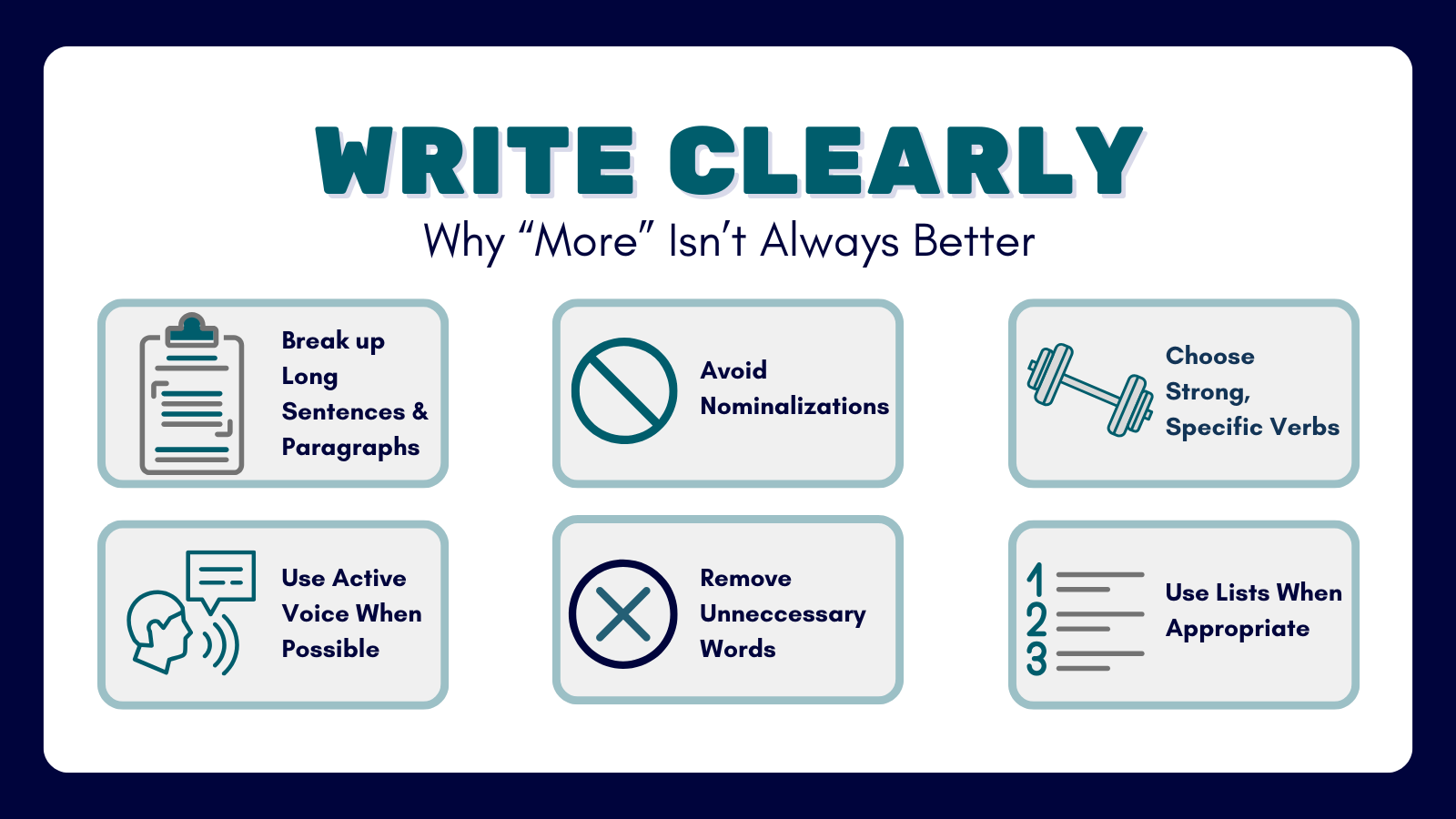
In this article, we present seven practical tips to help you write more clearly and effectively.
1. Break Up Long Sentences and Paragraphs
Long sentences are one of the most common causes of unclear writing. When a sentence stretches beyond 25–30 words, it is easy for readers to lose track of the main point.
Instead of packing multiple ideas into a single sentence, break them into shorter, focused statements. Each sentence should communicate one main idea.
Example
Less clear:
Our team will implement a comprehensive data management framework designed to enhance reporting capabilities while also improving accessibility for users across multiple departments.
Clearer:
Our team will implement a comprehensive data management framework. This approach improves reporting and makes data more accessible across departments.
Shorter sentences reduce cognitive load and help readers absorb information quickly.
Similarly, large blocks of text can overwhelm readers. Each paragraph should focus on a single idea or topic. If a paragraph begins to cover multiple points, consider splitting it. Shorter paragraphs make it easier for readers to scan and process information.
2. Avoid Nominalizations
Nominalizations occur when verbs are turned into nouns, often ending in -tion, -ment, or -ance. While they are sometimes necessary, they can make writing more abstract and wordier.
Whenever possible, convert nominalizations back into strong verbs.
Example
Wordy:
The implementation of the solution will result in the improvement of operational efficiency.
Clearer:
Implementing the solution will improve operational efficiency.
Strong verbs make writing more direct and easier to understand.
3. Choose Strong, Specific Verbs
Weak verbs like make, do, provide, conduct, or perform typically require additional words to explain what is happening.
Strong verbs communicate action more clearly and concisely.
Example
Weak:
Our team will conduct an analysis of system performance.
Stronger:
Our team will analyze system performance.
Replacing weak verb phrases with precise verbs makes writing sharper and more confident.
4. Remove Unnecessary Words
Many phrases in proposal writing add length without adding meaning. Words like very, really, quite, and in order to clutter your sentences.
Look for opportunities to tighten phrasing.
Examples
In order to → To
Due to the fact that → Because
At this point in time → Now
The goal isn’t to eliminate detail, it’s to eliminate filler.
5. Use Active Voice When Possible
Active voice makes it clear who is responsible for an action and typically produces shorter sentences.
Passive voice can be useful in certain situations, but overuse can make writing vague and indirect.
Example
Passive:
The report will be completed by the team next week.
Active:
The team will complete the report next week.
Active voice improves clarity and accountability.
6. Use Lists When Appropriate
When presenting multiple related items—steps, benefits, features, or requirements—lists can improve readability.
Lists allow readers to quickly understand key points without digging through dense paragraphs. They also highlight structure and make complex information easier to follow.
Final Thoughts
When readers can quickly understand your message, they are far more likely to absorb your ideas and act on them. Remember: strong writing isn’t measured by how many words you use. It’s measured by how clearly those words communicate your message.