Improve Your Win Rate with Smarter Bid Decisions
How Applying Rigor in Your Bid Decisions Will Improve Your Win Rate
Winning more proposals isn’t just about writing better—it starts much earlier with making smarter decisions about which opportunities to pursue. Yet many organizations struggle with the discipline required to say “no,” especially after time, energy, and resources have already been invested in an opportunity. When the pressure to maintain pipeline volume or recover sunk costs takes over, teams often find themselves chasing pursuits with little realistic chance of success. One of the most effective ways to improve win rates, protect team capacity, and focus resources where they matter most is by applying greater rigor to the bid decision process. In today's article, we take a deeper look at one of the most important tactics for improving proposal outcomes: making smart, data-informed bid decisions.
Make Smart Bid Decisions
One key reason win rates may be low is that the company is making poor bid decisions. This is a hard one for many companies because it is so difficult to ignore the sunk costs that have gone into a pursuit; however, smart organizations will not discount the opportunity costs of developing and submitting a proposal with a low probability of win. With proposals, it’s critical to reassess the bid decision once the RFP is released and during key proposal and/or gate reviews. Critical questions to ask when making these important bid decisions include:
- Does the opportunity fit your business plan?
- Do you have an excellent customer relationship?
- Do you understand the customer’s goals, issues, and requirements?
- Do you have/can you get the people to support the requirement?
- Do you have the required experience/past performance? Can you team if not?
- Do you have the required corporate commitment and resources?
- Do you have a committed proposal team? Can you augment your staff with consultants if not?
With a live RFP, if the answer to any of the above is NO, you should think long and hard about pursuing the opportunity at hand.
Decision Matrices and Tools
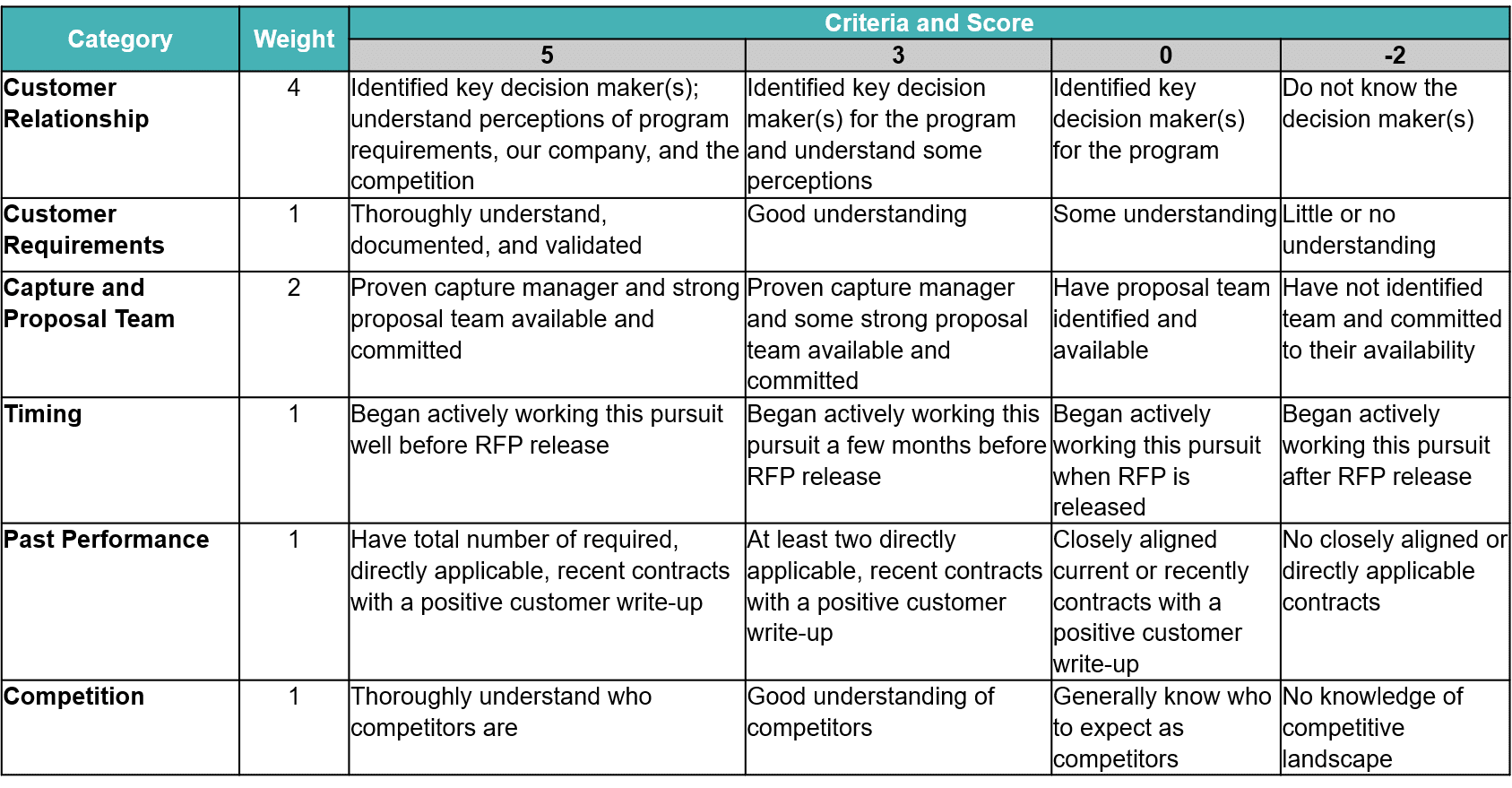
For some companies, it may be useful to create decision matrices to help inform the bid decision. The decision matrix shown below is fairly simple, taking six weighted areas and generating a score to better quantify the health of the potential opportunity. This particular matrix rates key areas, including customer relationship, customer requirements, capture plan and proposal team, timing, past performance, and competition to generate its score. Such matrices can range from fairly simple, like this one, to fairly complex. But the objective is the same—to help better inform the bid decision. When using a tool like this, companies will typically set thresholds that indicate almost certain or definite bids and definite no bids. For example, this matrix has a maximum score of 50, so the company might set the definite bid level at 45 and the definite no bid level at 30.
Table 1. Sample Bid Decision Matrix
Other Tools Available
The idea of math intimidates many proposal professionals, so there are also some less-manual tools available out there to help teams to better inform the bid decision process. For example, this article includes a link to a free Excel solution. I find the Excel table versions to be particularly useful because they can be dropped into gate review decks to help support the bid decision process during gate reviews—and the numbers can be adjusted easily as the capture plan and solution matures. If you’re looking for a user-friendly software solution, you can look at available tools such as BidScore. This AI-driven tool helps you make smarter bid decisions by providing you with a win probability after you answer a series of bid decision questions tailored to your organization.
Final Thoughts
In this world of bids and proposals, we all certainly want to win more. However, there are so many factors that impact a company’s probability of win, and a number of things throughout the opportunity lifecycle can impact a company’s chances of winning (both positively and negatively). However, one key thing that you can do to positively impact your chances of winning is to pass on the opportunities with a low win probability. In addition to lowering your overall win and capture rates, consistently pursuing opportunities with low win probabilities is an ineffective use of resources, which not only can cost your company several thousand dollars a year (or more!), it can burn out your staff, lower morale, and result in increased capture and proposal staff turnover.